
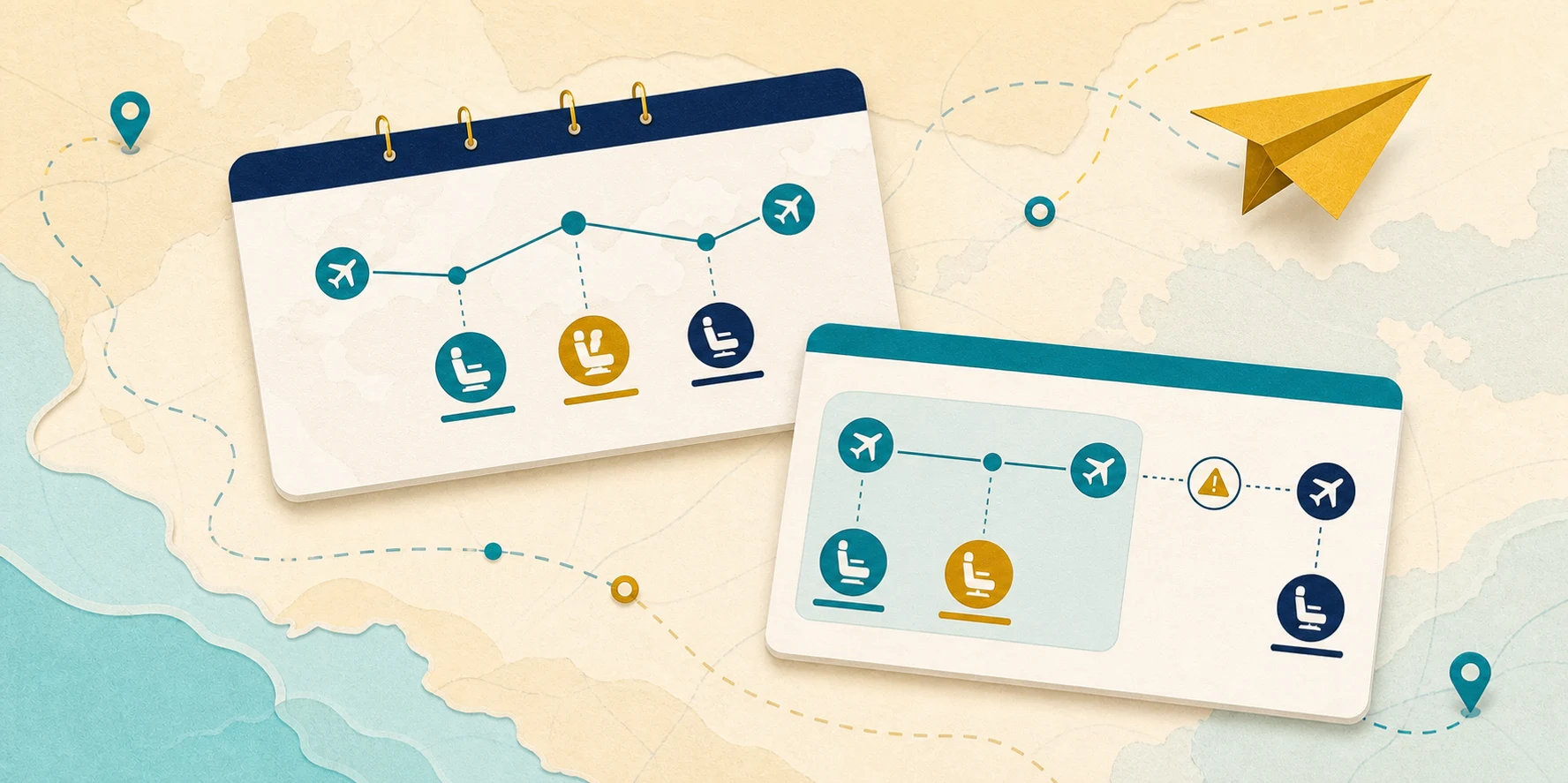
The word “business” in an award result does not tell you which flight is actually in business class. It may describe a short connection while the overnight flight is in economy. A promising itinerary can also require a separate positioning ticket that adds hours, cash cost, and a connection the main airline may not protect.
Before transferring points, expand the result and read the trip flight by flight. I want to know the operating airline, cabin, airport, ticket structure, and connection time for every segment. If one of those details is unclear, I do not yet have an itinerary I am ready to book.
For the broader comparison, use the whole-itinerary business-class scorecard. The checks below focus on two details that are especially easy to miss.
Find the segment that matters most
A mixed-cabin award uses more than one cabin across the itinerary. That is not automatically a bad booking. The important question is where the lower cabin appears.
I am usually comfortable with a short first segment in a lower cabin when the longest or most important flight has the comfort I need. I become much less interested when the premium cabin applies only to the short flight and the long overnight segment is in economy.
For each flight, record:
- Operating airline and flight number
- Origin and destination airport
- Scheduled duration
- Cabin shown for that specific segment
- Whether the flight is daytime or overnight
- Seat or product details that matter to you
Do not infer the cabin from the first segment, the itinerary headline, or a colored “business” label. Check the details for every flight with the program that will issue the ticket. Aircraft and seats can change, so treat a specific seat type as something to verify, not a guarantee.
The mixed-cabin detail I noticed after booking
A few years ago, I was booking a round-trip business-class itinerary for my parents from New Delhi to San Francisco. The trip connected in Frankfurt in both directions, and I compared the options using the factors that seemed most important: total travel time, departure and arrival times, and price.
I had filtered the search for business class, so I assumed the whole itinerary would be in business class. I opened the flight details and checked the schedule and layovers. What I did not check was the cabin listed for every individual segment.
After clicking through and booking directly with United, I opened the confirmation email and finally saw the problem. New Delhi to Frankfurt was Lufthansa business class. Frankfurt to San Francisco and the return to Frankfurt were United business class. But the final Frankfurt-to-New Delhi flight—about nine hours—was in economy, not even premium economy.
There had been no mixed-cabin warning or label at the search-result level. I would have caught the problem if I had checked the cabin inside the details for all four segments, but I had not.
I freaked out for a moment, called United, and canceled while I was still within the 24-hour cancellation window. Then I started the search again. In the end, I lost some time and learned a lasting lesson. My parents avoided spending the final nine hours of the trip in an economy seat they were not expecting.
Since then, I have never treated a business-class filter as proof that every flight is in business class. The label gets me to a set of results. The segment details tell me what I am actually booking.
Treat a positioning flight as a separate trip
A positioning flight takes you from your home airport to the airport where the main award begins. It can unlock a much better long-haul option, but it adds another ticket, another check-in, and another opportunity for the itinerary to fail.
Before using one, add:
- The positioning fare, taxes, bags, seats, and ground transportation
- A hotel and meals if the safer plan requires arriving the day before
- The time from leaving home until the main award departs
- Baggage collection, immigration, security, terminal, or airport changes
- A recovery plan if the positioning flight is late or canceled
Do not assume bags will be checked through or that one airline will protect a flight booked on a separate ticket. Policies depend on the carriers and ticket structure. Verify the current handling with every relevant airline before booking.
Positioning works for me only when the added time and cost remain proportionate to the improvement over leaving from my home airport. A very short self-connection with little or no buffer is not an improvement, even if the main award looks excellent.
Use three quick rejection checks
Reject or pause an itinerary when any of these is true:
- The wrong segment has the premium cabin. The flight where comfort matters most does not meet the trip’s minimum.
- The connection risk is doing too much work. Separate tickets, bags, an airport change, or a thin buffer could break a trip that needs to happen.
- The complete trip is no longer a good trade. Positioning, hotels, cash costs, or extra hours overwhelm the improvement in cabin or mileage price.
My own rough warning line is an all-business option that requires two or more stops or takes about 40% longer than the fastest reasonable itinerary for the same origin and destination. That is a personal filter, not a universal rule. The right boundary depends on the trip, the traveler, and the alternatives actually available.
Read the itinerary in this order: schedule, connections, separate-ticket risk, cabin by segment, complete cost, and exit options. Then verify the live award again before transferring points. A premium label is useful only when the trip behind it still works.
For help comparing mixed cabins, positioning, and premium-cabin tradeoffs for a real trip, explore Business Class Awards. You remain in control of every account, transfer, and booking decision.
Airline procedures, award availability, mileage prices, equipment, cabins, and program rules can change. Verify the exact itinerary and current official terms before transferring points or booking.